


 Nike
Nike
 Adidas
 Asics
Asics
 K-Swiss
 New Balance
 On
On
 Wilson
 Babolat
 Head
Head
 Nike
Nike
 Wilson
 K-Swiss
 Babolat
 Nike
Nike
 Asics
Asics
 K-Swiss
 New Balance
 On
On
 Wilson
 Babolat
 Head
Head
 Lacoste
 Tecnifibre
 Wilson
 Penguin
 Boss
Boss
 Diadora
 Lucky in Love
 Lacoste
 Sofibella
 Lija
Lija
 On
On
 Bubble
 Boast
Boast
 Girl's Lucky in Love
 Fila
Fila
 Lacoste
 Tecnifibre
 Yonex
Yonex
 Dunlop
 Tecnifibre
 Solinco
 Mizuno
 Volkl
Volkl
 Mizuno Demos
 Volkl Demos
 Yonex Demos
 Babolat
 Volkl
Volkl
 Ame & Lulu
 CourtLife
 Dunlop
 Geau Sport
 Glove It
 Solinco
 Trelle and Co.
 Gamma
Gamma
 Penn
Penn
 Volkl
Volkl


 Adidas
 Dunlop
 Gamma
Gamma
 Head
Head
 Lucky in Love
 Tail
Tail
 Tennis Express
 Tourna
 Jannik Sinner
 Carlos Alcaraz
 Novak Djokovic
 Alexander Zverev
 Ben Shelton
 Daniil Medvedev
 Tommy Paul
 Casper Ruud
 Lorenzo Musetti
 Rafael Jodar
 Aryna Sabalenka
 Elena Rybakina
 Iga Swiatek
 Coco Gauff
 Jessica Pegula
 Mirra Andreeva
 Amanda Anisimova
 Alexandra Eala
 Elina Svitolina
 Victoria Mboko
 CRBN
CRBN
 RPM
RPM
 Engage
 Gearbox
 Holbrook
 Joola
Joola
 Paddletek
 Selkirk
 Franklin Sports
 Gamma
Gamma
 Nox
Nox
 Onix
Onix
 Selkirk
 Vulcan
 Acacia Sports
 Diadora
 Reebok
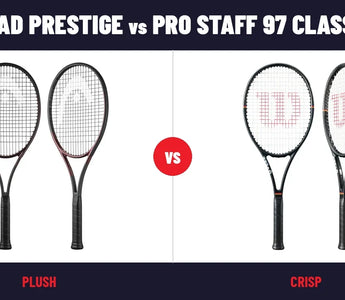
HEAD's Prestige Pro, Prestige Tour and Wilson's Pro Staff 97 Classic are three of the most demanding control racquets you can buy. All three reward players who swing long, fast, and clean, but they deliver two different flavors of control. The Prestige models play with a softer, plush feel, while the Pro Staff brings an old-school crisp response and more pop than you might expect. Here's how the three compare and which one fits your game.
In This Post
How the Three Line Up
Start with the Prestige Tour and Pro Staff 97 Classic, because they share more than most rival racquets do. Both weigh 11.1 ounces unstrung and 11.7 ounces strung, both are 27 inches long, and both list an open 16x19 pattern. The Tour rates 65 on the RA flex scale and the Pro Staff rates 66. On paper that's close. On court, they feel like two different racquets, and that difference comes down to feel, which we'll get to below.
What the Prestige Tour and Pro Staff 97 Classic Share
- 11.1 ounces (315 grams) unstrung, 11.7 ounces (332 grams) strung
- 27-inch length
- 16x19 string pattern
- Flex ratings one point apart (65 and 66 RA)
The Prestige Pro is the outlier. At 11.3 ounces unstrung and 11.9 ounces strung, it's the heaviest of the three, and it pairs the thinnest beam in the group (20mm) with the densest pattern (18x20) and the most flexible frame (60 RA). Yet it shares the Pro Staff's 7-point head-light balance, and its 325 swingweight sits just 1 point under the Wilson.
Where the Pro Staff 97 Classic Sits
- Head size: between the Prestige Pro (98 square inches) and Prestige Tour (95)
- Beam: between the Prestige Pro (20mm) and Prestige Tour (22mm)
- Swingweight: between the Prestige Pro (325) and Prestige Tour (329)
- Flex: the firmest of the three at 66 RA
In other words, the Pro Staff lands in the middle of the two Prestige models on most specs. What sets it apart is feel. Both Prestige models play soft and plush, and the Pro Staff plays firm and crisp.
HEAD Prestige Pro: The Thin-Beam Specialist

The Prestige Pro is not an easy racquet, and it isn't meant to be. It packs a thin 20mm beam and a tight 18x20 pattern into a 98-square-inch head, a combination built to reward a full, committed swing rather than bail you out on a late or mishit ball. It's the heaviest racquet in this comparison, but a 7-point head-light balance and a 325 swingweight keep that weight in the handle so it never feels front-heavy.
HEAD's Auxetic 2.0 construction runs from the bridge down into the end of the grip, a structure designed to react to the racquet's flex at contact and give real-time feedback on each shot. Paired with a Full Cap grommet system and the elongated shaft the Prestige has carried since 1987, the Pro delivers a soft, plush feel at contact and the flattest, most controlled ball flight of the three racquets here.
String recommendation: HEAD Hawk Touch 17 at 50 pounds.
Shop the HEAD Prestige ProHEAD Prestige Tour: Precision First

The Tour is the most modern member of the current Prestige family. It pairs a compact 95-square-inch head with a 22mm beam and a 16x19 pattern, which opens the string bed up for more spin than the tighter 18x20 layout on the Prestige Pro.
A 6-point head-light balance and a 329 swingweight give it the highest swingweight of the three, even with the smallest head. That extra mass moving through the ball helps the Tour hold its line against heavy pace and send it back with depth. HEAD builds the frame with Graphene and its Auxetic 2.0 construction at the bridge and handle, a combination designed to give clear, real-time feedback on every shot instead of muting it.
Like the rest of the Prestige line, the Tour doesn't offer much help. Its head is the smallest here, so the sweet spot is tighter and off-center contact gets punished. In exchange, you get a soft, plush feel, a flat, predictable response, and the kind of precision that lets you put the ball exactly where you intend. For a closer look at the Prestige models, see our Prestige Guide.
The Prestige Line on Tour
String recommendation: HEAD Hawk Touch 17 at 50 pounds.
Shop the HEAD Prestige TourWilson Pro Staff 97 Classic: Stability and Crisp Feel

The Pro Staff line traces back to Pete Sampras and Roger Federer, and the 97 Classic carries that heritage forward with a retro-inspired cosmetic on a demanding spec sheet. It pairs a 97-square-inch head with a thin, straight 21.5mm beam and braided graphite construction, the material the Pro Staff built its reputation on.
Its 7-point head-light balance matches the Prestige Pro and puts a bit more weight in the handle than the Prestige Tour, and its 326 swingweight sits between the two HEADs. The result is a racquet that feels a touch quicker to whip around than the Tour while still delivering the stability and crisp feel the Pro Staff name is known for.
It's also a throwback. Most modern control frames flex softer, and the Pro Staff's firmer build gives it an old-school, crisp response along with more power than you'd expect from a control racquet. Strike the ball cleanly and it comes off the strings with real pace.
The cosmetic looks back, but the tech is current. Wilson's Braid 45 construction lays double-braided fibers at a 45-degree angle for stability and a pocketed feel at contact, and Paradigm Bending Technology tunes the flex between the hoop and shaft. The Classic also uses string mapping, which spaces the strings tighter through the center of the string bed for a more precise, consistent response. So while it shares a 16x19 listing with the Prestige Tour, the Pro Staff's string bed is laid out differently.
Read our Wilson Pro Staff Classic review for a full breakdown, or see how it compares with Wilson's other control frame in our Pro Staff 97 Classic vs. Blade 98 v10 guide.
The Pro Staff 97 on Tour
Spec Comparison
| Spec | HEAD Prestige Pro | HEAD Prestige Tour | Wilson Pro Staff 97 Classic |
|---|---|---|---|
| Head Size | 98 sq. in. | 95 sq. in. | 97 sq. in. |
| Length | 27 in. | 27 in. | 27 in. |
| Weight (Unstrung) | 11.3 oz / 320 g | 11.1 oz / 315 g | 11.1 oz / 315 g |
| Weight (Strung) | 11.9 oz / 337 g | 11.7 oz / 332 g | 11.7 oz / 332 g |
| Balance | 7 pts head light | 6 pts head light | 7 pts head light |
| Swingweight | 325 | 329 | 326 |
| Beam Width | 20mm | 22mm | 21.5mm |
| Flex (RA) | 60 | 65 | 66 |
| String Pattern | 18x20 | 16x19 | 16x19 |
| Composition | Graphene / Auxetic / Graphite | Graphene / Auxetic / Graphite | Braided Graphite |
How They Play Differently
Sweet Spot and Forgiveness
None of these racquets is forgiving, but head size still matters. The Prestige Pro has the largest head at 98 square inches, though its thin beam and dense pattern offer little free power, so mishits tend to land short. The Pro Staff 97 Classic's 97 square inches give you a bit of room on stretched defensive shots and returns, and it still asks you to hit cleanly and swing through the ball with confidence. The Prestige Tour, with the smallest head, asks for the cleanest contact of the three.
Stability and Plow-Through
With the highest swingweight and a balance that carries a bit more mass toward the head, the Prestige Tour tends to feel the most solid through contact against big hitters. The Prestige Pro and Pro Staff sit close together here, with matching 7-point head-light balances and swingweights 1 point apart. The Pro Staff swings more easily than an 11.1-ounce frame usually does, and the Prestige Pro's extra static weight gives it a planted feel in the hand without slowing it down.
Spin and Trajectory
The Prestige Pro's 18x20 pattern produces the flattest, lowest ball flight of the three. That's ideal for players who drive the ball through the court and want every shot to stay on a tight line, less so for heavy-topspin players. The Prestige Tour and Pro Staff both list 16x19, which gives more spin and a higher launch, and the Pro Staff's string mapping tightens up the center of its string bed for extra precision.
Feel at Contact
This is the real dividing line, and it splits the three into two flavors of control. Both Prestige models play with a softer, plush feel that holds the ball on the strings and gives smooth, predictable feedback. The Prestige Pro, at 60 RA, is the most flexible frame here, and the Tour follows the same soft Prestige character.
The Pro Staff 97 Classic goes the other way. Its firmer flex gives it an old-school, crisp feel, and its braided layup and mapped string bed deliver feedback so direct that you know where the ball will land as soon as it leaves the strings. That firmer build also makes it a surprisingly powerful control racquet. It's a throwback to how control frames used to play before the category shifted toward softer flexes.
Which Should You Choose?
All three racquets are built for advanced players with long, fast swings who want control first, and none will bail you out on a late swing. The biggest decision is feel: the soft, plush response of the Prestige models or the crisp, firmer response of the Pro Staff. From there, it comes down to the ball flight you want and how much margin you need.
- Pick the HEAD Prestige Pro if: You hit flat, generate your own pace, and want a soft, plush feel with the densest pattern and the most controlled ball flight of the group.
- Pick the HEAD Prestige Tour if: You hit the ball cleanly and want that same soft Prestige feel with a bit more spin and a frame that feels heavier through contact.
- Pick the Wilson Pro Staff 97 Classic if: You want control with an old-school, crisp feel, a firmer flex and more power than most control frames offer, plus a quicker feel in the hand.
Still deciding? Browse our full selection of control tennis racquets.
FAQ
Which of the three racquets is the heaviest?
The Prestige Pro, at 11.3 ounces unstrung and 11.9 ounces strung. The Prestige Tour and Pro Staff 97 Classic both weigh 11.1 ounces unstrung and 11.7 ounces strung. The Prestige Tour has the highest swingweight (329), though, so it can feel the heaviest in motion.
Which racquet is the most forgiving?
None of the three is a forgiving racquet. The Prestige Pro has the largest head (98 square inches) but a thin beam and dense pattern that offer little free power. The Pro Staff 97 Classic's 97-square-inch head gives a bit more room for error than the Prestige Tour's 95.
Are these racquets good for intermediate players?
All three are demanding frames aimed at advanced players. Intermediate players will usually get more out of a lighter racquet with a larger head. If you like the Pro Staff feel, Wilson also makes the Pro Staff 97L Classic (10.2 ounces unstrung) and the Pro Staff Team Classic (9.9 ounces unstrung) as lighter options. Our guide to the best tennis racquets for intermediate players is a good place to start.
Can I try these racquets before buying?
Yes. Our demo racquet program lets you test frames from HEAD, Wilson, and other brands on court before you commit.


![You Got Served Unisex Tennis Tee White-Apparel-TENNIS EXPRESS-TESERVED18-1-1-[Sku]-Tennis Express](http://tennisexpress.com/cdn/shop/files/TESERVED18-1.webp?v=1769458091&width=298)

