


 Nike
Nike
 Adidas
 Asics
Asics
 K-Swiss
 New Balance
 On
On
 Wilson
 Babolat
 Head
Head
 Nike
Nike
 Wilson
 K-Swiss
 Babolat
 Nike
Nike
 Asics
Asics
 K-Swiss
 New Balance
 On
On
 Wilson
 Babolat
 Head
Head
 Lacoste
 Tecnifibre
 Wilson
 Penguin
 Boss
Boss
 Diadora
 Lucky in Love
 Lacoste
 Sofibella
 Lija
Lija
 On
On
 Bubble
 Boast
Boast
 Girl's Lucky in Love
 Fila
Fila
 Lacoste
 Tecnifibre
 Yonex
Yonex
 Dunlop
 Tecnifibre
 Solinco
 Mizuno
 Volkl
Volkl
 Mizuno Demos
 Volkl Demos
 Yonex Demos
 Babolat
 Volkl
Volkl
 Ame & Lulu
 CourtLife
 Dunlop
 Geau Sport
 Glove It
 Solinco
 Trelle and Co.
 Gamma
Gamma
 Penn
Penn
 Volkl
Volkl


 Adidas
 Dunlop
 Gamma
Gamma
 Head
Head
 Lucky in Love
 Tennis Express
 Tourna
 Jannik Sinner
 Carlos Alcaraz
 Novak Djokovic
 Alexander Zverev
 Ben Shelton
 Daniil Medvedev
 Tommy Paul
 Casper Ruud
 Lorenzo Musetti
 Rafael Jodar
 Aryna Sabalenka
 Elena Rybakina
 Iga Swiatek
 Coco Gauff
 Jessica Pegula
 Mirra Andreeva
 Amanda Anisimova
 Alexandra Eala
 Elina Svitolina
 Victoria Mboko
 CRBN
CRBN
 RPM
RPM
 Engage
 Gearbox
 Holbrook
 Joola
Joola
 Paddletek
 Selkirk
 Franklin Sports
 Gamma
Gamma
 Nox
Nox
 Onix
Onix
 Selkirk
 Vulcan
 Acacia Sports
 Diadora
 Reebok
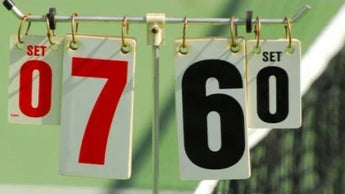
If you've ever watched a set end at 7-6 and wondered what just happened, you've already seen a tiebreak in action. Understanding what is a tiebreak in tennis means knowing when it kicks in, how the points are counted, and why the rules can look a little different depending on the event you're watching or playing. This guide breaks it all down, from standard 7-point tiebreaks to super tiebreaks, so you can follow any scoreboard with confidence.
What Is a Tiebreak in Tennis?
A tiebreak is how a set gets decided when both players (or teams) win 6 games each, for a score of 6-6. Rather than trading games indefinitely, the set comes down to one tiebreak game played to seven points. First to seven wins the tiebreak, wins the set, and the final score reads 7-6.
That last part catches a lot of new fans off guard. The set score always shows 7-6, no matter how the tiebreak itself unfolded. The actual tiebreak score appears separately in parentheses on a scoreboard, so you'll often see something like 7-6 (4), meaning the losing player won four points during the tiebreak.
The reason tiebreaks exist is straightforward: tennis needed a reliable way to end sets without matches spiraling out of control. Before the tiebreak arrived in the early 1970s, sets could go on indefinitely with no ceiling. That one change reshaped everything from broadcast schedules to how players manage their energy across a long match.
For anyone newer to the game, here's the key thing to hold onto: a tiebreak is still tennis. Same court, same players, same rackets. It's just a compressed, high-stakes version of scoring built to reach a fair decision quickly. Points are counted as 1, 2, 3 rather than 15, 30, 40, but the competitive logic stays exactly the same: win more points than your opponent.
If you want a solid foundation on how tennis scoring works around a tiebreak, our tennis scoring guide walks you through it all in plain terms.
When Does a Tiebreak Happen in a Set?
A tiebreak usually happens when a set reaches 6-6. At that point, both players or teams have won six games, so the set needs a clearer finish. If you want a quick refresher on how games build into a set, this guide on what is a set in tennis helps set the stage.
That 6-6 scoreline is the basic trigger, but tennis tiebreak rules are not identical in every format.
Here are the most common setups:
- Standard tournaments: In many pro and amateur events, a standard 7-point tiebreaker in tennis is played at 6-6 to decide the set, including the final set.
- Grand Slams: All four majors now use the same final-set rule. If the final set reaches 6-6, players play a 10-point match tiebreak to decide the match. That change created a more consistent system across the Australian Open, Roland Garros, Wimbledon, and the US Open.
- League and recreational play: This is where things can really vary. Some leagues use a regular 7-point tiebreak at 6-6. Others replace a full final set with a 10-point super tiebreak, especially in doubles or time-limited matches.
So, what is a tiebreak in tennis really about at this stage? It is the set-deciding format that kicks in when the score is tied late, but the exact version depends on the event. Always check the format before you play or follow a scoreboard.
How Tiebreakers Are Scored Point by Point
Once you understand the basic structure, tennis tiebreak scoring clicks pretty fast. The first player to reach 7 points wins — but with a catch. You have to win by at least 2, so a tight tiebreak can push well beyond that 7-point mark before anyone takes the set.
Here's how the mechanics break down:
- Points count as 1, 2, 3 and up — not 15, 30, 40 like a regular game.
- The player who was next due to serve starts the tiebreak with one service point.
- After that opening point, serve alternates every two points for the rest of the tiebreak.
- Players switch ends of the court after every 6 points played.
- The tiebreak ends when one player reaches 7 points and leads by at least 2.
Quick Example: A Tiebreak in Real Time
Player A: 7 | Player B: 5
The score builds like this: 1-0, 1-1, 2-1, 2-2, 3-2, 4-2, 4-3, 5-3, 5-4, 6-4, 6-5, 7-5. Player A closes it out.
This is also why serving well under pressure matters so much in a tiebreak. A clean ace at 6-6 doesn't just win a point — it can completely flip the momentum.
Because of the win-by-2 rule, scores like 9-7 or even 11-9 are completely normal. Extended tiebreaks happen, and they're some of the most intense moments the sport has to offer. Every point is its own mini pressure test, and the players who stay composed are usually the ones who come out on top.
What Is a Super Tiebreak or Match Tiebreak?
A super tiebreak, sometimes called a match tiebreak, follows the same basic rules as a standard tiebreak but goes a bit further. Instead of racing to 7 points, players compete to 10, still needing to win by 2. In many formats, it replaces a full third set entirely, so one extended tiebreak decides the whole match.
You'll run into super tiebreaks in quite a few common situations:
- Doubles matches at both professional and recreational events
- Mixed doubles at Grand Slams, including the US Open and Australian Open
- USTA league play and recreational formats where court time is limited
- Tournament brackets using condensed scheduling to keep things moving
Quick Reference: Standard Tiebreak = First to 7 points (win by 2) | Super Tiebreak = First to 10 points (win by 2)
It's easy to see why organizers favor this format. It keeps match schedules on track without draining the competitive tension, since every single point still carries real weight. It also goes easier on players physically, which matters a lot in multi-match tournaments where recovery time is short.
If you're heading into an event that uses this format, showing up prepared is half the battle. Check out Tennis Express's tournament tennis gear to make sure you have everything you need before the first point is played.

Why Tiebreak Rules Can Change by Event
One reason tennis tiebreak rules can feel confusing is that the format is not exactly the same everywhere. The basics stay familiar, but tournaments, leagues, and match types can still use different versions of a tiebreaker in tennis.
A good example is major events. Grand Slams now use a match-deciding tiebreak in the final set when that set reaches 6-6, but the exact tiebreak format may differ from the standard 7-point version players see earlier in a match. In doubles, it is also common to replace a full third set with a 10-point match tiebreak, especially on the pro tour, in college tennis, and in many recreational formats.
That same idea carries over to club play, junior events, and USTA leagues. Some matches use a regular 7-point tiebreak at 6-6 in every set. Others use a super tiebreak instead of a final set. A few formats may even have special scoring rules to keep play moving on schedule.
The practical takeaway is simple: if you want to know what happens in a tennis tiebreak, check the event format first. Once you know whether the match uses standard tennis tiebreak scoring or a super tiebreak, the scoreboard gets much easier to read. That is a big part of understanding what is a tiebreak in tennis in the real world.


![You Got Served Unisex Tennis Tee White-Apparel-TENNIS EXPRESS-TESERVED18-1-1-[Sku]-Tennis Express](http://tennisexpress.com/cdn/shop/files/TESERVED18-1.webp?v=1769458091&width=298)

