


 Nike
Nike
 Adidas
 Asics
Asics
 K-Swiss
 New Balance
 On
On
 Wilson
 Babolat
 Head
Head
 Nike
Nike
 Wilson
 K-Swiss
 Babolat
 Nike
Nike
 Asics
Asics
 K-Swiss
 New Balance
 On
On
 Wilson
 Babolat
 Head
Head
 Lacoste
 Tecnifibre
 Wilson
 Penguin
 Boss
Boss
 Diadora
 Lucky in Love
 Lacoste
 Sofibella
 Lija
Lija
 On
On
 Bubble
 Boast
Boast
 Girl's Lucky in Love
 Fila
Fila
 Lacoste
 Tecnifibre
 Yonex
Yonex
 Dunlop
 Tecnifibre
 Solinco
 Mizuno
 Volkl
Volkl
 Mizuno Demos
 Volkl Demos
 Yonex Demos
 Babolat
 Volkl
Volkl
 Ame & Lulu
 CourtLife
 Dunlop
 Geau Sport
 Glove It
 Solinco
 Trelle and Co.
 Gamma
Gamma
 Penn
Penn
 Volkl
Volkl


 Adidas
 Dunlop
 Gamma
Gamma
 Head
Head
 Lucky in Love
 Tail
Tail
 Tennis Express
 Tourna
 Jannik Sinner
 Carlos Alcaraz
 Novak Djokovic
 Alexander Zverev
 Ben Shelton
 Daniil Medvedev
 Tommy Paul
 Casper Ruud
 Lorenzo Musetti
 Rafael Jodar
 Aryna Sabalenka
 Elena Rybakina
 Iga Swiatek
 Coco Gauff
 Jessica Pegula
 Mirra Andreeva
 Amanda Anisimova
 Alexandra Eala
 Elina Svitolina
 Victoria Mboko
 CRBN
CRBN
 RPM
RPM
 Engage
 Gearbox
 Holbrook
 Joola
Joola
 Paddletek
 Selkirk
 Franklin Sports
 Gamma
Gamma
 Nox
Nox
 Onix
Onix
 Selkirk
 Vulcan
 Acacia Sports
 Diadora
 Reebok
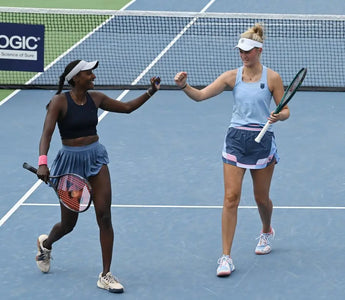
Tennis has two formats, and the rules between them are more different than most players expect. This guide walks through everything that changes in singles vs doubles tennis, from court dimensions and serving order to positioning and match strategy. Whether you're new to the game or just switching formats, knowing these rules keeps you from learning them the hard way mid-match.
Singles vs Doubles Tennis: What Actually Changes?
Whether you're picking up a racket for the first time or switching formats at your local club, understanding the difference between singles and doubles tennis changes how you approach every point.
Singles is one-on-one. You cover the entire court alone, owning every shot and decision from the first serve to the last ball. Doubles puts two players on each side, which shifts everything — how you position yourself, how much court you're responsible for, and how well you communicate with your partner under pressure.
The differences run deeper than just headcount. In singles vs doubles tennis, the playable court actually changes size. Serving rotation works differently. Strategy adjusts based on how much ground you need to cover and where your opponents are standing. Even the mental side of the game changes when you have a partner to rely on or when you don't.

For beginners, knowing these distinctions upfront saves real confusion during a match. For competitive players, the rules between formats are specific enough that mixing them up can cost you points in ways that feel entirely avoidable.
This article breaks down exactly what changes, starting with court dimensions and lines, then moving through scoring, serving order, positioning, and match strategy. If any terms feel unfamiliar along the way, keep the Tennis Express Tennis Glossary handy as a quick reference.
By the end, you'll have a clear, practical picture of how each format works and why those rules actually matter when you're out on court.
Court Size, Lines, and Where You're Allowed to Hit
The most immediate difference you'll notice between singles and doubles tennis is how much of the court is actually in play. A standard tennis court is 36 feet wide, but in singles, only the inner 27 feet count. Those extra strips along each sideline, the alleys, are completely out of bounds in singles and fully live in doubles. Simple concept, big strategic impact.
| Feature | Singles | Doubles |
|---|---|---|
| Court Width | 27 feet | 36 feet |
| Sideline Used | Inner sideline | Outer sideline |
| Alley Status | Out of play | In play |
Those nine feet of difference shape everything about how players move and position themselves:
- Singles players control a narrower court, so positioning centers around owning the middle and cutting off sharp crosscourt angles before they develop.
- Doubles teams split the width between two players, and those alleys become a constant threat. Both partners have to stay honest about their sideline coverage.
- Landing a ball in the alley during singles hands your opponent a free point. In doubles, it's a legitimate weapon for dragging defenders out of position.
- Doubles positioning tends to be more vertical (one up, one back, or both at the net), while singles positioning is more lateral and reactive.
Getting the court layout straight is the foundation for everything else in singles vs doubles tennis. It also matters more than most people expect because the surface you're playing on — hard, clay, or grass — directly affects how quickly players can cover those boundaries and recover after each shot.
How Scoring Works in Singles and Doubles
The basic scoring system stays the same in singles and doubles tennis: love, 15, 30, 40, deuce, and advantage all work the same way. Games build into sets, and sets make up the match. If you want a full refresher on the basics, check out our tennis scoring guide.
| Rule | Singles | Doubles |
|---|---|---|
| Point Scoring | Same traditional tennis scoring | Same traditional tennis scoring |
| Serving Order | One player serves each full game, then players alternate games | Each team sets a serving order, and all four players keep that rotation through the set |
| Standard Tiebreak | Usually played at 6-6, first to 7 points and win by 2 | Same scoring, but service rotates through all four players in order |
| Second Serves / Lets | Same rules | Same rules |
The biggest differences beginners notice in singles vs doubles tennis usually come from rotation, not from how points are counted.
In doubles, each team chooses a serving order at the start of the set. Teams also choose which player will receive serve on the deuce side and which player will receive on the ad side. Those receiving sides stay the same for that set.
A few common doubles formats can also change the feel of scoring. For example, some recreational and league matches use no-ad scoring, where the next point after deuce decides the game. Others replace a full third set with a 10-point match tiebreak. Those are format-specific variations, not universal doubles tennis rules.
So when comparing the difference between singles and doubles tennis, the scoring language is familiar. The extra layer is simply keeping track of serve order, return sides, and any local format tweaks.
Serving, Rotation, and Positioning: Who Stands Where?
Serving and positioning are a big part of the difference between singles and doubles tennis. In singles, it's simple: one player serves the whole game, one player returns, and each player covers their own side without worrying about a partner's movement.
In doubles, the order matters more.
| Singles | Doubles | |
|---|---|---|
| Serving Order | One player serves the entire game; players alternate serving games | Teammates alternate service games, and that serving order is locked in for the set |
| Receiving Order | The same player receives every serve in that game | The receiving team chooses who takes serves in the deuce court and who takes serves in the ad court, and that order stays fixed for the set |
| Court Positioning | Server and returner usually start near the baseline | The server's partner usually starts at the net, while the returner's partner can play up or back depending on strategy |
That fixed order is one of the key doubles tennis rules beginners often miss. If Player A receives first in the deuce court, Player B must take the next point in the ad court, and the same pattern continues whenever that team is returning in that set.
Positioning adds another layer. The server's partner is active at net and can poach, cutting off a cross-court return with a volley. A strong serve makes that even more effective by forcing a weaker return. Meanwhile, the returning team has to place the ball carefully, usually cross-court, to avoid feeding the net player.
That's why singles vs doubles tennis feels so different. Singles is about solo coverage. Doubles is about patterns, communication, and moving as a team.
Strategy and Match Play: Why Singles Feels Different from Doubles
The rules shape the game, but they also shape how you think on court. That shift in mindset is one of the most noticeable things about playing singles vs doubles tennis.
In singles, the whole court is yours to cover. Every wide ball, every drop shot, every deep drive lands squarely on you. Points tend to run longer, and your fitness becomes a real factor. You're building rallies with purpose, moving your opponent side to side, waiting for the short ball, then attacking. Consistency and patience aren't just nice to have — they're how points get won. There's no partner to bail you out when you get stretched wide.
Doubles feels like a different sport. With two players splitting the court, points are shorter and the net is where the action happens. You're talking to your partner constantly, adjusting positions, and looking for chances to poach. That's when one player cuts across to intercept a return before it reaches their partner, and it's one of the most effective weapons in doubles. Reaction time counts for more than baseline endurance here. A strong serve-and-volley game, which can feel risky in singles, suddenly makes a lot of sense when the angles open up.
None of this is random. The wider court, the rotating serve order and the positioning rules all feed directly into these tactical realities. Doubles rewards coordination and quick instincts. Singles rewards consistency and mental toughness.
If you want to build skills that translate across both formats, check out these ten tips for improving your tennis game.


![You Got Served Unisex Tennis Tee White-Apparel-TENNIS EXPRESS-TESERVED18-1-1-[Sku]-Tennis Express](http://tennisexpress.com/cdn/shop/files/TESERVED18-1.webp?v=1769458091&width=298)

