


 Nike
Nike
 Adidas
 Asics
Asics
 K-Swiss
 New Balance
 On
On
 Wilson
 Babolat
 Head
Head
 Nike
Nike
 Wilson
 K-Swiss
 Babolat
 Nike
Nike
 Asics
Asics
 K-Swiss
 New Balance
 On
On
 Wilson
 Babolat
 Head
Head
 Lacoste
 Tecnifibre
 Wilson
 Penguin
 Boss
Boss
 Diadora
 Lucky in Love
 Lacoste
 Sofibella
 Lija
Lija
 On
On
 Bubble
 Boast
Boast
 Girl's Lucky in Love
 Fila
Fila
 Lacoste
 Tecnifibre
 Yonex
Yonex
 Dunlop
 Tecnifibre
 Solinco
 Mizuno
 Volkl
Volkl
 Mizuno Demos
 Volkl Demos
 Yonex Demos
 Babolat
 Volkl
Volkl
 Ame & Lulu
 CourtLife
 Dunlop
 Geau Sport
 Glove It
 Solinco
 Trelle and Co.
 Gamma
Gamma
 Penn
Penn
 Volkl
Volkl


 Adidas
 Dunlop
 Gamma
Gamma
 Head
Head
 Lucky in Love
 Tail
Tail
 Tennis Express
 Tourna
 Jannik Sinner
 Carlos Alcaraz
 Novak Djokovic
 Alexander Zverev
 Ben Shelton
 Daniil Medvedev
 Tommy Paul
 Casper Ruud
 Lorenzo Musetti
 Rafael Jodar
 Aryna Sabalenka
 Elena Rybakina
 Iga Swiatek
 Coco Gauff
 Jessica Pegula
 Mirra Andreeva
 Amanda Anisimova
 Alexandra Eala
 Elina Svitolina
 Victoria Mboko
 CRBN
CRBN
 RPM
RPM
 Engage
 Gearbox
 Holbrook
 Joola
Joola
 Paddletek
 Selkirk
 Franklin Sports
 Gamma
Gamma
 Nox
Nox
 Onix
Onix
 Selkirk
 Vulcan
 Acacia Sports
 Diadora
 Reebok
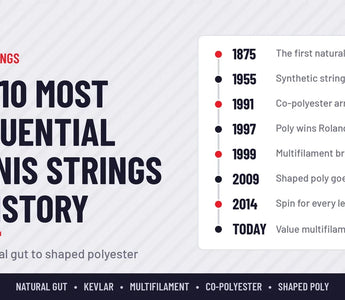
Racquets get most of the attention, but strings decide how the ball comes off them. A handful of strings have changed the way tennis is played, from the red clay of Roland Garros to the courts at your local club. Here are 10 of the most influential tennis strings in history, in roughly the order they made their mark.
Babolat VS Touch

Every conversation about tennis strings starts with natural gut, and Babolat VS is the name players think of first. Natural gut offers a mix of comfort, power, and ball pocketing that no synthetic has fully matched, which is why VS Touch remains the measuring stick by which all natural gut is judged.
The current version adds Babolat's BT7 coating on top of its earlier Thermogut treatment. Babolat says BT7 improves longevity by up to 15 percent, durability by 25 percent, and resistance to humidity by nearly 60 percent. VS Touch now comes in black as well as natural, and our testers found the black version plays very slightly stiffer while keeping the comfort and pop they love.
Today, VS Touch is the natural gut of choice in most of the poly and gut hybrids you'll see on the pro tour.
Ashaway Kevlar

Kevlar strings were built to outlast everything else in the racquet. Braided Kevlar mains resist notching and hold up to heavy hitters and chronic string breakers, and Ashaway's Kevlar became one of the first strings designed specifically for hybrid setups.
Its most famous user was Andre Agassi, who strung Ashaway Kevlar in the mains with Babolat VS gut in the crosses during the 1990s. The gut softened Kevlar's very stiff response, and the Kevlar kept the string bed intact through his heavy hitting.
Today's Ashaway Kevlar Plus blends PTFE filaments into the braided Kevlar for a softer feel, while keeping the durability that made the original famous. Kevlar was a precursor to polyester, and was regularly mixed with natural gut to prolong string life.
Luxilon Big Banger Original

Luxilon launched Big Banger Original in 1991, and it was one of the first co-polyester strings ever made. Compared with first-generation polyesters, it offered better feel and tension maintenance, along with the durability and control that would soon take over the pro tour.
It's a low-powered, stiff string built for baseliners who take full cuts and rely on spin to keep the ball in the court. That formula made it a key choice in the careers of Juan Carlos Ferrero, Marat Safin, David Nalbandian, Guillermo Coria and David Ferrer, and it's still one of the most popular strings on the ATP Tour.
Shop Luxilon Big Banger Original
Luxilon ALU Power

If Big Banger Original started the polyester era, ALU Power made it mainstream. Luxilon introduced Big Banger ALU Power in 1994, and in 1997 a little-known Gustavo Kuerten won the French Open with it in his racquet. Kuerten was one of the first players on tour to compete with polyester, and his title run turned the tennis world's attention to his strings. He went on to win the French Open three times.
Aluminum in the co-poly construction gives ALU Power a softer, more playable feel than earlier polyesters while still letting players take full swings without losing control. That made it the natural next step for most Big Banger Original players.
ALU Power became a fixture at the top of the game. Roger Federer paired Wilson Natural Gut mains with ALU Power Rough crosses, Andy Murray flipped the formula with ALU Power mains and Babolat VS Touch crosses, and Novak Djokovic and Juan Martin del Potro both relied on it. It's still widely used on the ATP and WTA tours. For more on setups like these, see our guide to top hybrid string choices.
Wilson NXT

While polyester was taking over the pro tour, Wilson NXT was changing the club game. Built from Xycro micro-fibers sealed in a polyurethane resin coating, NXT delivers a soft, powerful, arm-friendly response that comes remarkably close to natural gut. The USRSA rated it the No. 1 synthetic string for playability in 1999.
Wilson says NXT increases the size of the sweet spot by 10 percent and reduces shock by 74 percent compared with a traditional synthetic gut. That made it a go-to recommendation for players with tennis elbow and anyone who wants gut-like playability from a synthetic, and it's still one of the most popular multifilament strings in the world.
Tecnifibre X-One Biphase

Tecnifibre pioneered multifilament strings impregnated throughout with liquid polyurethane, and X-One Biphase is the flagship of that idea. It's built to give players the playability of natural gut in a synthetic string, and many players consider it the closest any synthetic has come.
Tecnifibre says its Elastyl fibers add about 12 percent more power than standard polyamide, and Trimerized PU builds on the brand's PU Inside technology for more comfort and touch. A high-temperature pre-stretching step helps the string hold tension, and the Biphase process increases durability by 20 percent. That process also gives X-One its look. At the end of production, the string passes between two toothed wheels that stretch it along its full length, leaving a pattern of darker and lighter shades.
Babolat RPM Hurricane

Many players still know it as Pro Hurricane Tour. Babolat now sells it as RPM Hurricane, and only the name has changed. Its octagonal profile grips the ball to generate topspin, and it plays firm and crisp, with solid control on big swings.
Hurricane brought a shaped, spin-focused profile to Babolat's polyester line, and it was a clear precursor to RPM Blast. It's still used on the ATP and WTA tours by players who want a firmer string bed with plenty of control and spin.
Babolat RPM Blast

The same way Big Banger Original players moved to ALU Power, Hurricane players moved to RPM Blast. Its octagonal, gear-like profile bites into the ball, but the edges are subtle, so the strings slide easily against each other and snap back into place. That movement is where the spin comes from, and a cross-linked silicone coating reduces friction between the mains and crosses to help it along. Not every shaped poly works this way. Some have edges sharp enough to get in the way of string movement.
Rafael Nadal started using RPM Blast in late 2009, and by September 2010 he had won the U.S. Open to complete a career Golden Slam. Arthur Fils plays RPM Blast today, and most of Babolat's pro players use an RPM string, either as a full bed or in a hybrid.
Solinco Hyper-G

Solinco launched Hyper-G in 2014, and its neon green color quickly became one of the most recognizable sights in tennis. Its square-shaped profile delivers big bite on the ball, and Solinco built it for a Top 50 ATP player who wanted a string that wasn't too firm or too soft but still let him take massive swings without overhitting.
Value is a big part of the Hyper-G story. It delivers tour-level spin and control at a lower price than many of the legacy brands, and that combination made it a favorite of college programs. Many pros inside the top 200 play it too. For a closer look, read our Solinco Hyper-G review.
HEAD Velocity MLT

The newest string on this list is already one of the most popular. HEAD Velocity MLT has picked up steam over the last couple of years and has been at or near the top of the best-selling strings in the U.S.
Two things set it apart. Most multifilament strings cost more, but Velocity delivers performance-level playability at a price that makes it easy to try. It also comes in black, blue, natural, yellow and pink, a rare range of colors for a multifilament.
On court, its flexible core of 1,000 filaments makes it arm-friendly with above-average shock absorption, while a low-friction outer coating adds spin and helps durability. It also works well in hybrids.
Honorable Mention: Synthetic Gut
Not every influential string has a famous name attached. Synthetic gut is the everyday string of recreational tennis and the first string many players ever hit with. It's also the baseline the other strings on this list get measured against. When Wilson says NXT reduces shock by 74 percent, the comparison is to a traditional synthetic gut.
Most synthetic guts share the same basic recipe: a solid nylon core with one or more outer wraps, built to be durable, comfortable, and affordable. Wilson, HEAD, and Babolat all make one, and Yonex's version, Dynawire, adds a thin metal film around the core for extra power and a silicone coating to help the strings snap back. For players who don't break strings often, a quality synthetic gut is still one of the best values in tennis.
Where Strings Go From Here
From natural gut to neon green co-poly, each of these strings changed what players expect from their racquets. Most of today's setups, from full beds of shaped polyester to gut and poly hybrids, trace back to something on this list.


![You Got Served Unisex Tennis Tee White-Apparel-TENNIS EXPRESS-TESERVED18-1-1-[Sku]-Tennis Express](http://tennisexpress.com/cdn/shop/files/TESERVED18-1.webp?v=1769458091&width=298)

