


 Nike
Nike
 Adidas
 Asics
Asics
 K-Swiss
 New Balance
 On
On
 Wilson
 Babolat
 Head
Head
 Nike
Nike
 Wilson
 K-Swiss
 Babolat
 Nike
Nike
 Asics
Asics
 K-Swiss
 New Balance
 On
On
 Wilson
 Babolat
 Head
Head
 Lacoste
 Tecnifibre
 Wilson
 Penguin
 Boss
Boss
 Diadora
 Lucky in Love
 Lacoste
 Sofibella
 Lija
Lija
 On
On
 Bubble
 Boast
Boast
 Girl's Lucky in Love
 Fila
Fila
 Lacoste
 Tecnifibre
 Yonex
Yonex
 Dunlop
 Tecnifibre
 Solinco
 Mizuno
 Volkl
Volkl
 Mizuno Demos
 Volkl Demos
 Yonex Demos
 Babolat
 Volkl
Volkl
 Ame & Lulu
 CourtLife
 Dunlop
 Geau Sport
 Glove It
 Solinco
 Trelle and Co.
 Gamma
Gamma
 Penn
Penn
 Volkl
Volkl


 Adidas
 Dunlop
 Gamma
Gamma
 Head
Head
 Lucky in Love
 Tail
Tail
 Tennis Express
 Tourna
 Jannik Sinner
 Carlos Alcaraz
 Novak Djokovic
 Alexander Zverev
 Ben Shelton
 Daniil Medvedev
 Tommy Paul
 Casper Ruud
 Lorenzo Musetti
 Rafael Jodar
 Aryna Sabalenka
 Elena Rybakina
 Iga Swiatek
 Coco Gauff
 Jessica Pegula
 Mirra Andreeva
 Amanda Anisimova
 Alexandra Eala
 Elina Svitolina
 Victoria Mboko
 CRBN
CRBN
 RPM
RPM
 Engage
 Gearbox
 Holbrook
 Joola
Joola
 Paddletek
 Selkirk
 Franklin Sports
 Gamma
Gamma
 Nox
Nox
 Onix
Onix
 Selkirk
 Vulcan
 Acacia Sports
 Diadora
 Reebok
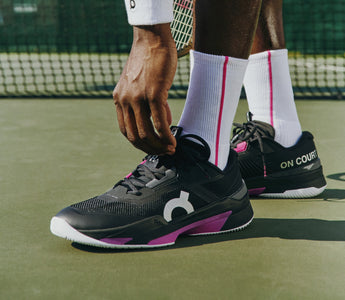
You might think shoes are shoes, right? After all, both running and tennis involve moving your feet. But here's the thing: wearing running shoes for tennis is like bringing a butter knife to cut steak. It might work for a minute, but you're setting yourself up for problems.
The Big Differences That Matter

Running shoes are built for one thing: forward motion. They've got thick, cushy heels designed to absorb impact when your foot strikes the ground in that heel-to-toe rolling motion. Tennis? That's a whole different beast. You're moving sideways, backwards, spinning, stopping on a dime, then exploding forward again. Your shoes need to handle all that chaos.

Tennis shoes come with reinforced sides for those aggressive lateral movements. The toe area? Extra durable because you'll drag it during serves. The sole pattern is specifically designed for quick direction changes without rolling your ankle. And that lower profile keeps you stable and connected to the court, rather than perched up high on cushioning you don't need.
Court Surfaces Change Everything
Here's where it gets interesting. Not all tennis shoes are created equal because not all courts are the same. At Tennis Express, you'll find shoes designed for specific surfaces, and trust me, the differences matter.

Hard court shoes are the workhorses of tennis footwear. They feature durable outsoles that can handle the abrasive concrete or asphalt surfaces without wearing down after three matches. The tread pattern typically offers a good balance of grip and give for those quick pivots.

Clay court shoes have a herringbone tread pattern that grips the loose surface while still letting you slide into shots (that classic clay court move). The pattern also prevents clay from clogging up the grooves, which would turn your shoes into ice skates.

Grass court shoes are the specialty items of tennis footwear. They have pimpled outsoles that grip the slippery grass without damaging the court. Think of them like cleats, but gentler. Most recreational players won't need these unless they're lucky enough to play on grass regularly.

Indoor court shoes feature non-marking soles that won't scuff up those pristine gym floors. They usually have a gum rubber outsole that provides excellent grip on smooth surfaces.
The Price of Wrong Footwear
Wearing the wrong shoes isn't just about performance (though you'll definitely notice your game suffering). It's about injury prevention. Tennis involves approximately 4-5 direction changes per point. Your knees, ankles, and hips take a beating with all that starting and stopping. Running shoes simply aren't built to support your foot during lateral movements, making rolled ankles and knee problems way more likely.
Bottom Line
Could you play tennis in running shoes? Sure, the same way you could eat soup with a fork. But why make things harder on yourself? Proper tennis shoes give you better performance, better protection, and honestly, they'll probably last longer too since they're built for the punishment tennis dishes out. Your feet (and your game) will thank you for making the switch.


![You Got Served Unisex Tennis Tee White-Apparel-TENNIS EXPRESS-TESERVED18-1-1-[Sku]-Tennis Express](http://tennisexpress.com/cdn/shop/files/TESERVED18-1.webp?v=1769458091&width=298)

