


 Nike
Nike
 Adidas
 Asics
Asics
 K-Swiss
 New Balance
 On
On
 Wilson
 Babolat
 Head
Head
 Nike
Nike
 Wilson
 K-Swiss
 Babolat
 Nike
Nike
 Asics
Asics
 K-Swiss
 New Balance
 On
On
 Wilson
 Babolat
 Head
Head
 Lacoste
 Tecnifibre
 Wilson
 Penguin
 Boss
Boss
 Diadora
 Lucky in Love
 Lacoste
 Sofibella
 Lija
Lija
 On
On
 Bubble
 Boast
Boast
 Girl's Lucky in Love
 Fila
Fila
 Lacoste
 Tecnifibre
 Yonex
Yonex
 Dunlop
 Tecnifibre
 Solinco
 Mizuno
 Volkl
Volkl
 Mizuno Demos
 Volkl Demos
 Yonex Demos
 Babolat
 Volkl
Volkl
 Ame & Lulu
 CourtLife
 Dunlop
 Geau Sport
 Glove It
 Solinco
 Trelle and Co.
 Gamma
Gamma
 Penn
Penn
 Volkl
Volkl


 Adidas
 Dunlop
 Gamma
Gamma
 Head
Head
 Lucky in Love
 Tennis Express
 Tourna
 Jannik Sinner
 Carlos Alcaraz
 Novak Djokovic
 Alexander Zverev
 Ben Shelton
 Daniil Medvedev
 Tommy Paul
 Casper Ruud
 Lorenzo Musetti
 Rafael Jodar
 Aryna Sabalenka
 Elena Rybakina
 Iga Swiatek
 Coco Gauff
 Jessica Pegula
 Mirra Andreeva
 Amanda Anisimova
 Alexandra Eala
 Elina Svitolina
 Victoria Mboko
 CRBN
CRBN
 RPM
RPM
 Engage
 Gearbox
 Holbrook
 Joola
Joola
 Paddletek
 Selkirk
 Franklin Sports
 Gamma
Gamma
 Nox
Nox
 Onix
Onix
 Selkirk
 Vulcan
 Acacia Sports
 Diadora
 Reebok
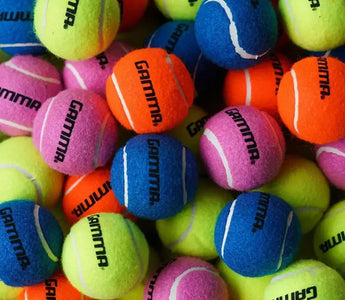
Ever wondered what’s inside that fuzzy yellow sphere you’re hitting back and forth? Tennis balls might look simple, but they’re actually sophisticated pieces of sports equipment with several components working together. Let’s take a closer look at what goes into making these essential pieces of tennis gear and how top brands like Wilson, Penn, and Babolat perfect their performance.
The Rubber Core at the Heart of Every Ball
At the center of every tennis ball lies a hollow rubber core built from a specially formulated compound designed for optimal bounce and durability. The core is molded from two half-shells joined together to form a seamless sphere. Each shell maintains a consistent 3 mm thickness to deliver reliable rebound on every shot. Manufacturers often use a blend of natural and synthetic rubber to balance elasticity, responsiveness, and longevity.

Pressurized vs. Pressureless Construction
There are two main types of tennis balls: pressurized and pressureless. Pressurized balls, like the Wilson US Open Extra Duty Tennis Balls, contain compressed air inside the core to enhance liveliness and spin potential. Wilson’s premium-grade rubber core is engineered to maintain consistent pressure and provide that satisfying "pop" on impact that competitive players love. These balls are used in professional tournaments, including the US Open, for their unmatched consistency and feel on hard courts.
Pressureless balls rely on thicker rubber walls rather than internal air pressure to generate bounce. While they are not commonly used in tournaments, they are ideal for practice and training sessions because they retain their playability over time.
The Fuzzy Felt Covering
That familiar fuzzy exterior is technically called the nap and it’s not just for looks. It affects speed and spin. The felt covering is typically made from a blend of wool and nylon, with the highest-quality balls using around 65 %–70 % wool for a superior feel. Each ball’s felt is cut into two dumbbell-shaped pieces, glued over the core, and steamed to achieve the perfect texture and durability.
For example, Penn Championship Extra Duty Tennis Balls use a natural rubber core wrapped in extra-duty felt designed specifically for hard courts. The felt is woven tightly to resist wear and maintain consistent performance even during extended rallies. The ball’s controlled core composition helps it keep its bounce longer, making it a favorite among recreational and league players.
Similarly, Babolat Gold All Court Tennis Balls feature a pressurized core with natural rubber and premium felt for versatility across all surfaces. Their Extra Pressurized Rubber (EPR) technology ensures a lively response while the high-quality felt maintains visibility and spin control in a variety of conditions.

The Chemistry Behind the Color
Though we call them yellow, tennis balls are technically “optic yellow,” a fluorescent yellow-green chosen to improve visibility on television and in real-time play. The dyes used are engineered to resist fading from UV exposure and the abrasions of court surfaces, ensuring that your Wilson, Penn, or Babolat balls stay bright match after match.
Built for Performance
Modern tennis balls are remarkable feats of engineering that combine material science with performance-driven design. Whether it’s the Wilson US Open Extra Duty balls trusted by the pros, the Penn Championship Extra Duty balls loved by everyday players, or the Babolat Gold All Court balls built for versatility, each model reflects a legacy of precision and innovation.
Next time you open a can, take a moment to appreciate the craftsmanship inside every bounce and know that each ball is built to deliver reliable performance from the first serve to the final rally.


![You Got Served Unisex Tennis Tee White-Apparel-TENNIS EXPRESS-TESERVED18-1-1-[Sku]-Tennis Express](http://tennisexpress.com/cdn/shop/files/TESERVED18-1.webp?v=1769458091&width=298)

